

Your dog used to come when you called. They used to sit nicely for their dinner. They used to actually look at you during training.
Now? They've discovered the world is far more interesting than you are. And honestly, from their perspective, they're not wrong, there's a lot to investigate out there. But it doesn't make it any less frustrating when your once-lovely puppy suddenly has the recall of a potato.
What's actually going on, and what to do about it.
Their brain is under construction
Between about six months and two years, your dog's brain is going through a major rewire. The prefrontal cortex, the part responsible for impulse control and decision-making, is still developing. So when your adolescent dog looks you dead in the eye and then does the exact thing you just asked them not to do, they're not being defiant. Their brain is genuinely not finished yet.
Think of it like this: they have the body of an adult (or close to it) but the emotional regulation of a much younger dog. Physical maturity and emotional maturity don't happen at the same pace. A one-year-old Labrador might weigh 30kg and still have the self-control of a puppy. That mismatch is where most of the chaos comes from.
How long does this last?
It depends on the dog. Most breeds hit adolescence somewhere between six months and two years. Smaller breeds tend to move through it faster, some are out the other side by 12 months. Larger breeds (and some of the more energetic working breeds like Border Collies and Kelpies) can take two to three years to settle emotionally.
It does end. But what you do during this period matters, the habits that form now are the ones you'll be living with for the next decade.
What actually helps
Stay consistent, even when it feels pointless.
Your adolescent dog is testing every boundary you set. That's normal. But if the rules change depending on your mood or how tired you are, they'll learn that persistence pays off, and you'll end up with a dog who's been accidentally trained to ignore you. Keep the rules the same, every day, even on the bad days.
Reward what you want to see more of.
This is the foundation of everything we do. When your dog checks in with you on a walk, even for a second, mark it and reward it. When they choose to lie down instead of jumping on a visitor, that's the behaviour you pay for. Food, toys, play, access to the garden, use whatever your dog finds reinforcing. The more you notice and reward the good stuff, the more of it you'll get.
Keep training sessions short.
Five minutes of focused work is worth more than thirty minutes of frustration. Adolescent dogs have the attention span of a goldfish on a good day. Work in short bursts, end on a win, and call it done. You can always do another session later.
Don't stop socialising them.
The adolescent phase is when a lot of owners pull back on socialisation because their dog is being embarrassing in public. Resist that urge. Continued exposure to different environments, surfaces, sounds, and people (done at your dog's pace, not yours) is what builds a confident adult dog. Avoiding the world creates a dog who can't cope with it.
Increase their enrichment.
A bored adolescent dog will find their own entertainment, and it usually involves something you'd rather they didn't chew, dig, or bark at. Make sure they're getting enough physical exercise and, just as importantly, mental stimulation. Scatter feeding, food puzzles, nose work games, and decompression walks where they get to sniff and explore all help burn off that adolescent energy in a constructive way. If you're struggling to fit it all in, here's what actually works when you're time-poor.
The stuff that drives everyone mad
Recall vanishing overnight
Your dog used to come back every time. Now they pretend they've never heard their name. Practice recall in low-distraction environments first, your hallway, your backyard, and build up gradually. Don't keep calling their name in situations where you know they won't respond. Every time they ignore you, they're practising ignoring you.
Pulling on the lead
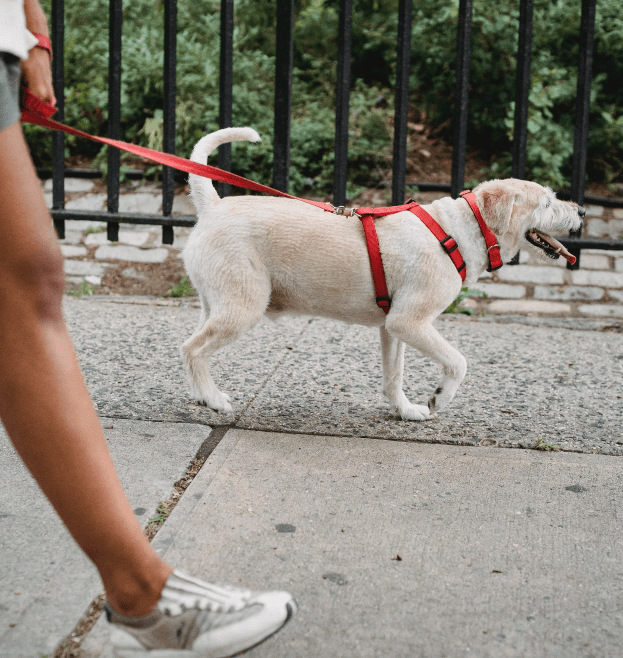
Adolescent dogs are strong, enthusiastic, and have zero concept of matching your walking pace. Loose-lead walking is a skill that takes time to build. If you're battling this every day, a front-clip harness can help while you work on the training, and our group classes cover this specifically because it's the number one thing people struggle with.
Jumping on everyone
They're excited. They're big. They don't understand why not everyone wants 25kg of adolescent dog launched at their chest. Teach an alternative: four paws on the floor gets the attention, jumping up makes the person turn away. Be consistent with every person who walks through your door, not just some of them.
Nala's story
Christina and Mitch came to us with Nala, an Australian Cobberdog living in a townhouse with two teenage daughters and Schmoo, the 12-year-old family cat. Every evening around 9pm, Nala would hit what the family called the "witching hour", jumping, growling, bitey play, completely wired. She was also barking at every door sound and car that went past. They'd had a Jack Russell before, but Nala was a different universe.
We set up proper management in the apartment to reduce the evening hyperarousal, introduced pattern games and concept training to give her brain something constructive to do, and worked specifically on settling around Schmoo instead of chasing. Christina saw improvement within the first week.
In her words: "Don't hesitate, just book." Nala's now been through puppy school, group classes, Canine Adventures, and private training at home, the full range of our programs.
The part nobody tells you
This phase is hard. There will be days where you wonder whether you got the wrong dog, whether the training is working, or whether things will ever get easier. They will. But it takes consistency, and it takes time, and on the tough days it's worth remembering that your dog isn't giving you a hard time, they're having a hard time.
If you're finding that the usual approaches aren't cutting it, or your dog's behaviour is escalating rather than settling, that's a good signal to get professional support sooner rather than later. Adolescent behaviour that gets ignored or handled incorrectly can harden into adult behaviour that's much more difficult to shift. We see this across Sydney, from apartments in the Inner West to houses in the Eastern Suburbs, and the families who reach out early almost always have a smoother run.