
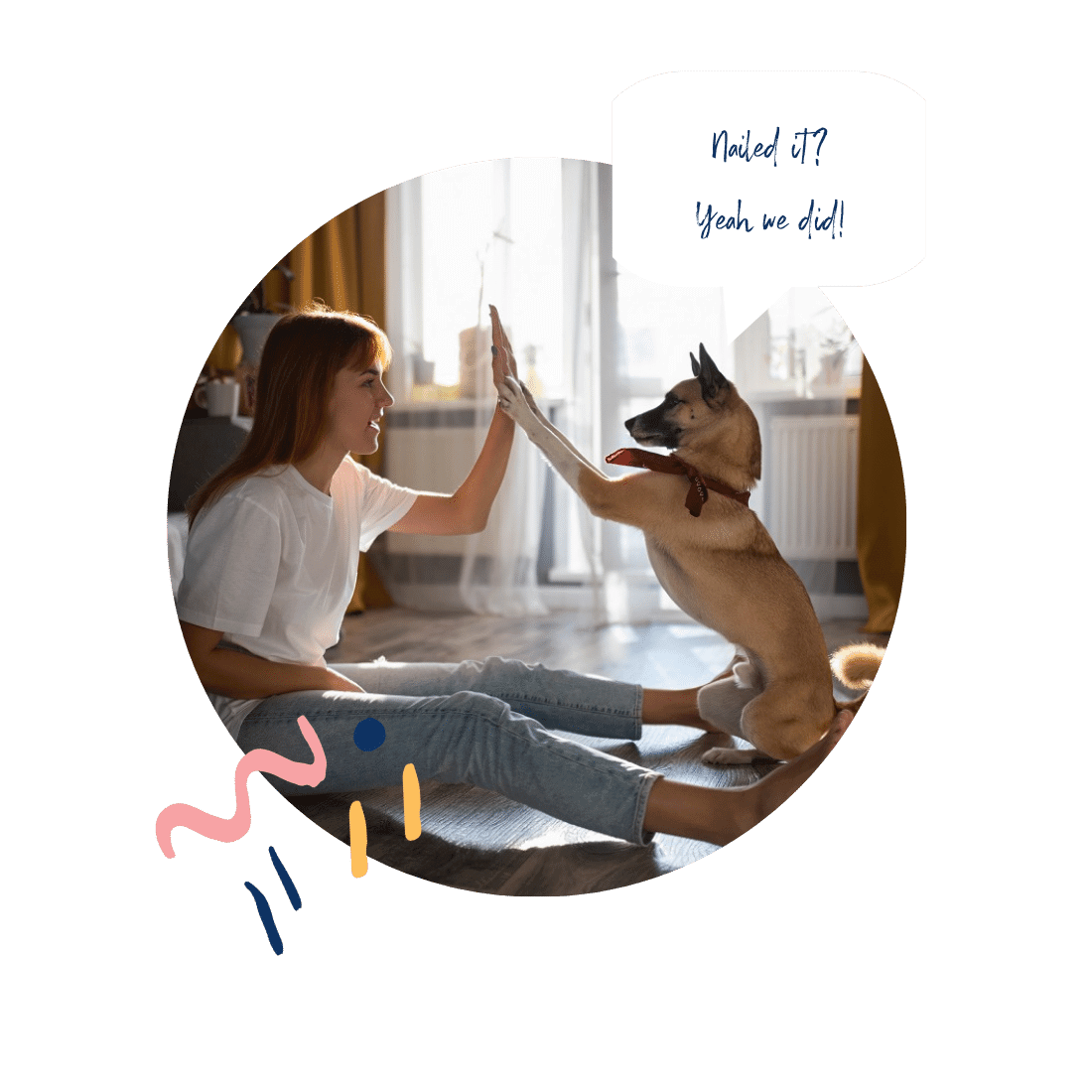
You've taught your dog to sit. Maybe even drop and stay. But when it actually matters (when the doorbell rings, when another dog walks past, when the postie arrives) none of it holds up.
That's not a failure of effort. It's a limitation of the method. Traditional obedience training teaches individual behaviours in controlled settings. The problem is, your dog's life isn't a controlled setting. And if your dog is going through adolescence, it's even harder. Their brain is literally under construction.
What games-based training does differently
Instead of drilling specific commands, games-based training builds the underlying concepts that make good behaviour possible: focus, impulse control, proximity, calmness, disengagement. When your dog has those foundations, the specific behaviours follow naturally, and they hold up in the real world, not just in your living room.
Each game is short (a few minutes at most), structured around one concept, and designed to be genuinely engaging for your dog. You're not asking them to repeat the same thing fifty times and hoping it sticks. You're setting up a situation where the thing you want them to learn is also the thing that's fun.
Focus
Your dog learns to check in with you, even when the world is full of distractions.
Impulse Control
The ability to pause and think before acting, instead of reacting on autopilot.
Calmness
Not just being still, but genuinely settling: a skill most dogs are never taught.
Proximity
Choosing to stay near you because it's rewarding, not because they're on a short lead.
Disengagement
The ability to notice something interesting and choose to look away. The foundation of recall and reactivity work.
How I got here
I'll be honest: when I first came across this approach, I thought it was too good to be true. I'd trained through traditional methods and assumed dogs needed structured repetition to learn. Games felt too easy.
Then I watched it work. Repeatedly.
The approach comes from trainers like Lauren Langman and Dr Tom Mitchell at Absolute Dogs in the UK, and Susan Garrett at Dogs That in Canada. They were getting remarkable real-world results, not through force, not through punishment, and not through ignoring unwanted behaviour, but through play.
I started introducing games into my puppy classes around 2018. Boundary games, focus and disengagement work, concept-based exercises. By 2019 I'd become an official Pro Dog Trainer through Absolute Dogs. In 2020 I added pattern games to the mix, studying under Leslie McDevitt, the creator of the "Look at That" game that many trainers now use for reactive dogs.
The combination of patterns, games, and concept training is what underpins everything we do at Pet Professor. It's how we get results that last beyond the session, and it's why our clients' dogs improve at home, on walks, and in the situations that used to be the hardest.
Squishy's story
Alicia was at breaking point. Squishy, her Havanese, had hit 11 months old and she was, in her own words, "questioning my decision to bring him into the family." He'd stopped listening, was barking constantly, and recall outside had completely vanished, especially around other dogs.
We took a two-pronged approach: private sessions at home to build Alicia's confidence as a handler, and trainer-led sessions in the park to proof those skills in the real world. Instead of drilling sit-stay-repeat, the training was built around games: attention games to build a fast recall foundation, name games to get Squishy choosing to check in, and disengagement work to teach him to notice other dogs and choose to look away instead of bolting.
The moment Alicia knew it had worked? The first time she took him to the park off-lead and he didn't bolt to the other dogs. When he played, he came back easily. People now regularly comment on "what a calm and lovely dog" Squishy is.
What this means for you
If your dog has been through training before and the results didn't stick, or if you've been doing the homework and it still feels like nothing's changing, it might not be about doing more. It might be about doing it differently. We see this across Sydney all the time: dogs who've done puppy school, maybe even an obedience course, and the owners are still struggling with the same problems at home and on walks.